Introduction
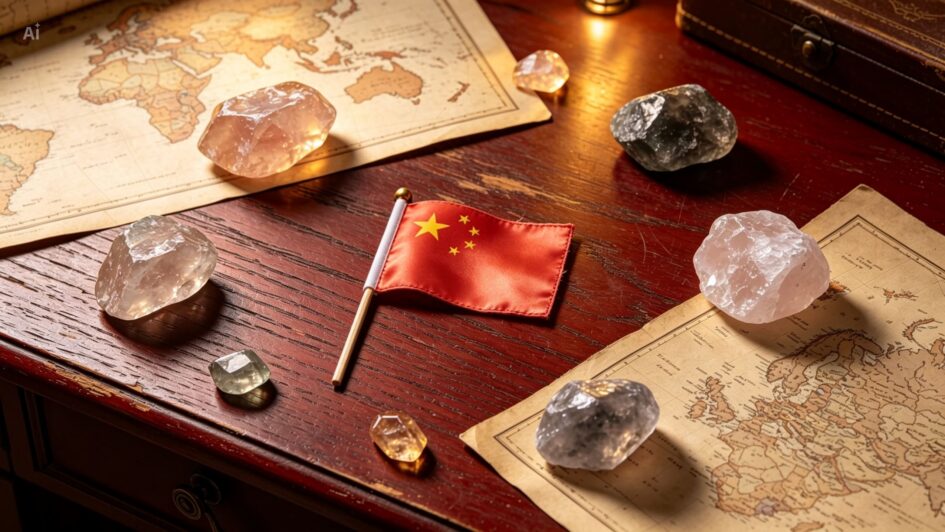
In April 2026, China’s Ministry of Commerce announced sweeping new export controls on seven of seventeen rare earth elements – samarium, gadolinium, terbium, dysprosium, lutetium, scandium, and yttrium – along with related magnets and processing technologies. The controls require foreign companies to secure individual export licenses for any product containing Chinese-sourced rare earth materials or produced using Chinese rare earth technology.
This move is the latest and most aggressive in a series of Chinese export controls on critical minerals dating back to 2023. It comes in direct response to the Trump administration’s April Section 232 tariffs on metals and pharmaceuticals and marks the most serious escalation yet in what is increasingly being described as a critical minerals cold war.
The implications stretch far beyond mining and metals. Rare earths and other critical minerals are essential inputs for electric vehicles, wind turbines, semiconductors, defence systems, robotics, smartphones, and the data centres powering the AI boom. China currently controls roughly 70% of global rare earth mining and over 90% of refining capacity, giving it extraordinary leverage over industries that account for trillions of dollars in global economic activity.
For investors, the critical minerals battleground creates winners and losers across dozens of sectors and presents one of the most significant geopolitical investment themes of the decade. This article breaks down what is happening, who benefits, who suffers, and what investors should watch as the rare earth supply chain is fundamentally restructured.
What Are Critical Minerals and Why Do They Matter?
Critical minerals are a group of metals and elements considered essential for modern industry and national security. The category includes rare earth elements, lithium, cobalt, nickel, copper, graphite, uranium, gallium, germanium, and several others. They share two characteristics: they are essential to high-value manufacturing, and their supply is concentrated in a small number of countries.
Rare earth elements are particularly important. Despite the name, they are not actually rare in the earth’s crust. What makes them difficult to source is that they are usually found in low concentrations and require complex, environmentally challenging refining processes to separate. China dominates the global rare earth supply chain not because it controls the deposits but because it has invested decades and billions of dollars in refining and processing capacity that other countries have not matched.
Heavy rare earth elements (HREEs) like dysprosium, terbium, and yttrium are the most strategically important. They are essential for the high-performance magnets used in electric vehicle motors, wind turbines, fighter jets, missile guidance systems, and MRI machines. There are virtually no commercial alternatives for many of these applications, making supply disruption a serious risk to industries representing trillions of dollars in economic output.
This dependence has been understood for years but largely tolerated. The April 2026 export controls have made the risk impossible to ignore.
China’s Export Control Strategy
China’s approach to critical mineral export controls has evolved rapidly over the past three years. The first restrictions came in mid-2023, targeting gallium and germanium, used in semiconductors and fibre optics. In late 2023, China added graphite, essential for EV batteries. Throughout 2024 and 2025, the list expanded to include tungsten, antimony, and an increasing range of rare earth elements.
The October 2025 export controls marked a significant escalation, applying restrictions extraterritorially to any foreign company shipping products containing Chinese-sourced rare earths or made with Chinese refining technology. The April 2026 measures intensify this further, formally targeting the seven rare earth elements most critical to defence and high-tech manufacturing.
The strategic logic is clear. China cannot match the West in semiconductor design or AI chip manufacturing, where it is constrained by US export controls of its own. But China holds asymmetric leverage in critical minerals, where the West is dependent on Chinese supply and cannot quickly build alternatives. By weaponising this dependence, Beijing can apply economic pressure across multiple Western industries simultaneously.
The April measures came in direct response to the Trump administration’s metals and pharmaceutical tariffs announced earlier the same month. The tit-for-tat nature of the exchange suggests further escalation is likely if either side continues raising stakes.
Sectors Most Exposed to the Rare Earth Squeeze
The April export controls target rare earth elements with very specific industrial uses. Understanding the downstream sectors is essential for assessing investment exposure.
Electric vehicles. Permanent magnets containing neodymium, praseodymium, dysprosium, and terbium are essential for the high-efficiency motors used in most modern EVs. A typical EV contains roughly 1-2 kilograms of rare earth materials. Tesla, BYD, Volkswagen, Toyota, and every other major EV manufacturer faces direct exposure. This compounds the tariff pressures already affecting automotive manufacturers from steel, aluminium, and copper duties.
Wind energy. Direct-drive wind turbines use roughly 200 kilograms of rare earth magnets per megawatt of capacity. Major wind turbine manufacturers including Vestas, Siemens Gamesa, GE Vernova, and Nordex all face supply chain risk.
Defence and aerospace. Modern fighter jets, including the F-35 program, contain hundreds of pounds of rare earth materials in their motors, sensors, and weapons systems. Missile guidance systems, radar arrays, and submarine sonar all depend on rare earth components. Lockheed Martin, RTX, Northrop Grumman, and other major defence contractors face significant supply concerns.
Semiconductors and electronics. Rare earths are used in chip polishing compounds, lasers, fibre optic cables, and consumer electronics manufacturing. Apple, Samsung, and the broader semiconductor supply chain have meaningful rare earth exposure.
Robotics and automation. Industrial robots, surgical robots, and increasingly common humanoid robots all use rare earth permanent magnets in their actuators and motors. This sector is particularly exposed because robotics demand is growing rapidly alongside AI deployment.
Medical devices. MRI machines depend on rare earth elements, particularly gadolinium-based contrast agents and dysprosium for shielding components. Hospital equipment manufacturers face sourcing challenges.
Wind, EVs, and defence together represent the largest demand drivers, accounting for the majority of global rare earth consumption outside of consumer electronics.
The US Response: Project Vault and Tariff Floors
Faced with the rare earth squeeze, the US government has launched the most aggressive critical minerals industrial policy in a generation.
In late 2025, the administration unveiled “Project Vault,” a $12 billion critical mineral strategic reserve programme modelled on the Strategic Petroleum Reserve. The goal is to stockpile sufficient quantities of key minerals to provide industry with a buffer against supply disruptions. The Department of Defense has been given expanded authority to make direct equity investments in domestic mining and refining companies.
The most significant intervention to date has been the Department of Defense’s $400 million equity investment in MP Materials, the operator of the only operating rare earth mine in the United States, at Mountain Pass in California. The agreement makes the US government MP’s largest shareholder and includes a 10-year price floor commitment of $110 per kilogram for neodymium-praseodymium products, providing the company with revenue certainty regardless of market price fluctuations.
In February 2026, Vice President JD Vance announced a broader “tariff floor” framework, setting reference prices for critical minerals that would automatically trigger tariffs if import prices fall below those levels. The aim is to protect domestic producers from Chinese price manipulation, a tactic Beijing has used historically to undercut Western mining startups before they reach commercial scale.
The US has also pursued bilateral and multilateral partnerships. In October 2025, the US and Australia signed a framework agreement to expand heavy rare earth element investments, including a $1 billion financing commitment and strategic stockpile coordination. Similar agreements have been pursued or signed with Canada, Greenland, Japan, and several African nations.
The challenge is time. Even with aggressive policy support, building new rare earth refining and magnet manufacturing capacity outside China is expected to take 10 to 15 years. In the near term, the US and its allies will remain heavily dependent on Chinese supply.
Winners: Domestic Miners and Refiners
The rare earth disruption has created clear winners among Western mining and refining companies, although the sector is small and highly volatile.
MP Materials is the most obvious beneficiary. With direct Department of Defense backing, a guaranteed price floor, and a $500 million supply agreement with Apple for rare earth magnets used in iPhone components, the company has become the cornerstone of US rare earth ambitions. Its stock has been one of the strongest performers in the materials sector.
Lynas Rare Earths is the largest producer of separated rare earths outside China. Headquartered in Australia with refining operations in Malaysia, Lynas is positioned as a key non-Chinese supplier. Its stock surged 14.5% in January 2026 after fresh Chinese export controls against Japan, and has continued to benefit from each new escalation. The company is building additional separation capacity in the United States with Pentagon support.
USA Rare Earth, Critical Metals Corp, Energy Fuels, NioCorp, and Ucore Rare Metals are smaller US and North American players developing new mining or refining projects. These are higher-risk bets but offer significant upside if their projects progress through permitting and construction.
Iluka Resources and Arafura Rare Earths in Australia are also building refining capacity with government support. Iluka is developing what could become Australia’s first commercial-scale refinery.
Defence contractors with vertical integration also benefit. Lockheed Martin, RTX, and others have begun investing in their own critical mineral supply chains, sometimes through joint ventures with mining companies, to insulate themselves from Chinese export controls.
For investors, the rare earth space offers a high-risk, high-reward exposure to the critical minerals theme. The sector is volatile, capital-intensive, and dependent on policy support, but the strategic importance of the materials means significant upside potential if Western capacity expands successfully.
Losers: Industries Caught in the Middle
The losers are industries that depend on rare earths as inputs without easy alternatives.
EV manufacturers face higher costs and potential production constraints. Companies with greater supply chain flexibility, including Tesla and BYD, are better positioned than those reliant on third-party magnet suppliers. Some manufacturers are exploring rare-earth-free motor designs, but these require trade-offs in efficiency and weight.
Wind turbine manufacturers are similarly exposed. Direct-drive turbines are highly dependent on rare earth magnets, and alternatives involving geared turbines come with reliability and maintenance trade-offs. The industry is investing in supply chain diversification but timelines are long.
Western semiconductor and electronics companies face indirect exposure. While the volumes of rare earths used per chip are small, supply disruption can cause significant production delays. The Hormuz crisis demonstrated this dynamic with helium shortages, and similar effects could emerge with rare earth-based polishing compounds and other inputs.
Industrial automation and robotics firms face higher input costs and supply uncertainty for the permanent magnet motors at the heart of their products. This comes at a time when the industry is scaling rapidly to meet AI-driven demand.
Smaller manufacturers without alternative suppliers or substantial inventories are most exposed. Larger companies with diversified sourcing and strategic stockpiles are better positioned to weather the disruption.
How the Critical Minerals Story Connects to Other Trade Themes
The rare earth controls fit into a broader pattern of supply chain reshuffling that has been underway for several years. The trade dynamics we have covered in previous articles all intersect with the critical minerals theme.
The Australia-China relationship is fundamentally shaped by Australia’s role as a key supplier of iron ore, lithium, and rare earths to China. As Western governments seek to diversify supply chains, Australia is positioned as a key partner, but it must balance this against its continued reliance on Chinese demand for traditional commodity exports.
The Canada-China trade deal included provisions on critical minerals, with Canada committing to expand mineral exports while easing EV tariffs in exchange for canola access. Canada is positioning itself as a major North American critical minerals supplier with substantial deposits of nickel, copper, lithium, cobalt, and rare earths.
The April Section 232 tariffs on copper directly connect to the critical minerals theme. Copper is essential for electrification and AI infrastructure, and the tariffs are designed in part to support domestic mining and refining capacity.
The Strait of Hormuz crisis showed how a single chokepoint can disrupt multiple industries simultaneously. The rare earth supply chain represents a different but equally vulnerable chokepoint, controlled not by geography but by Chinese industrial dominance.
For investors, the connecting thread across all these themes is the gradual fragmentation of globalised supply chains into more regional, more politically aligned production networks. This restructuring will take years to complete and will reshape investment opportunities across mining, manufacturing, defence, energy, and technology.
What Investors Should Watch
Several variables will determine how the critical minerals story unfolds:
- Further Chinese export controls. Beijing has additional minerals it could weaponise, including more rare earth elements, gallium, germanium, graphite, and tungsten. Watch for new announcements as part of escalating trade tensions.
- US-China trade negotiations. A US-China deal could include suspension of rare earth controls in exchange for tariff reductions. Watch for thaw signals from both governments.
- Project Vault execution. The size and pace of US strategic stockpiling will signal how seriously the administration is treating critical minerals security. Watch for procurement announcements and budget appropriations.
- MP Materials production milestones. As the cornerstone US rare earth producer, MP’s progress on refining capacity and magnet production is a key indicator for the broader Western supply chain effort.
- Lynas US facility commissioning. Lynas’s planned US refining facility, supported by Pentagon funding, is one of the most important non-Chinese projects under development.
- EV manufacturer supply chain disclosures. Watch for earnings calls and supply chain disclosures from major EV manufacturers indicating whether rare earth constraints are affecting production.
- Defence contractor vertical integration. Major defence companies investing directly in mining or refining ventures could create new investment opportunities and reshape the competitive landscape.
- Australian and Canadian government policy. Both governments are increasing support for domestic critical minerals industries. Subsidies, tax credits, and stockpile programmes could meaningfully change project economics.
Sector Implications and DCSC
The critical minerals battleground cuts across some of the most important sectors of the global economy, from mining and metals to electric vehicles, wind energy, defence, semiconductors, and robotics. DCSC’s Dynamic Company Sector Classification system tracks over 1,500 sectors, giving investors the granularity to map their portfolio exposure to specific critical minerals supply chains and identify both risks and opportunities.
Understanding which companies are exposed, which are positioned to benefit, and which are still struggling with sourcing decisions is essential for navigating the current environment.
The critical minerals story is likely to remain a defining investment theme for the rest of this decade. The combination of geopolitical pressure, industrial policy support, and structural demand growth from electrification, AI, and defence spending creates a multi-year setup that investors cannot afford to ignore.
Explore the full sector taxonomy at dcsc.ai.
Leave a Reply